An annual audit is not merely a statutory obligation and an additional burden. It is also an opportunity to gain a clear picture of your company’s financial position and confidence that its processes are working as intended.
Filter insights by:
Popular topics
Featured insights
The Ministry of Justice and Digital Affairs has prepared an extensive draft act amending the Commercial Code and other legislation. Its aim is to make the incorporation and management of companies and registry procedures more flexible, while also resolving issues that have caused disputes in practice.
We have prepared a comprehensive overview of European employment law, providing insight into the employment law frameworks across 15 key European jurisdictions. It is designed to help international employers better understand the regulatory landscape in different markets and the practical requirements that come with it.
Many employers have questions about whether and to what extent personal data can be requested from employees in the context of the coronavirus pandemic. In this article, I highlight some practical questions and concepts that employers should factor into processing of employee personal data and provide advice on how to mitigate the main risks for both employer and employee.
The law transposes the EU directive into Estonian law and entails an obligation for organizations to create internal and external reporting channels for reporting internal misconduct. The infringements that whistleblowers can report are very different - breaches of procurement procedures, internal fraud, breaches of environmental requirements, and so on.
The Danish tax authority increased the taxable income of Tetra Pak Processing Systems A/S due to shortcomings in transfer pricing documentation and continuous losses. The Danish Supreme Court reached the conclusion that the transfer pricing documentation filed by the company did not meet the requirements as the documentation lacked a competent comparability analysis.
Under the Occupational Health and Safety Act, employers must compile a risk assessment of the working environment. It is mandatory for employers who have at least one employee (security institutions excluded).
Maintaining proper accounting on transfer prices and documenting the reasoning for conformity to market value is in the interests of every enterprise, as it avoids tax risks. In preparing documentation, the requirements of legal acts should be considered along with the specific company’s risks and needs.
Something that family businesses should consider besides earning a profit is maintaining mutual relations between family members and devoting attention early on to questions of succession if the business is to stay in the family.
In the post-pandemic landscape, a new model of leadership will be needed to enable organisations to thrive. Engendering innovation, collaborating and communicating across the business, and adapting to change have become operational necessities, while empathy and inclusion are the keys to team performance.
The Automotive Industry is one of the sectors in which very large investments are being made. Although the coronary pandemic has caused serious disruption to car production, which accounts for the main share of the car industry, the sector as a whole is making significant progress in the coming years.
It has been a year and a few months since the coronavirus turned a new page in world history and exploded all comfort zones. Since that time, Estonia has beaten back two waves of the virus, and like last spring, we are now facing a calmer period. But this brings up new questions – how to return little by little to ordinary working life and juggle the needs of companies and employees while taking into account the way work will be organized in future.
Companies that sell physical goods to European countries all too often have to grapple with the destination country’s complicated VAT system, but in summer 2021, the situation will become simpler and the administrative expenses related to declaration of taxes will decrease.
The Ministry of Environment recently weighed in on packaging audit requirements. This topic pertains in particular to packaging undertakings who have already filed a packaging report for 2020 with the packaging register.
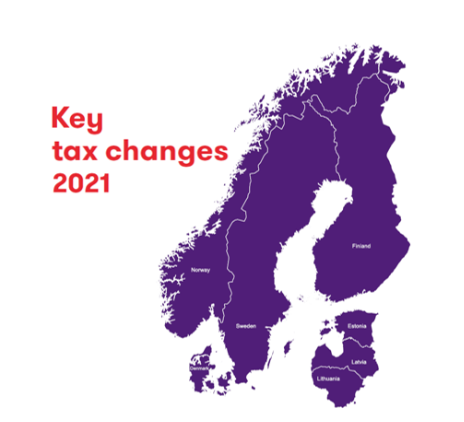
In the beginning of the year, several tax changes were introduced in Nordic-Baltic region. In addition we shall highlight tax rates applicable in the Nordic-Baltic region as of 2021.
The OECD (Organisation for Economic Co-operation and Development) regularly updates its 2017 transfer pricing guidance. It is worth keeping up to date with the OECD guidelines because transfer pricing regulations in Estonia and many other countries rely on the OECD’s guidelines.
A new guide has been produced by the Auditors’ Association and the Ministry of Finance for public sector entities conducting procurements for audit services. The manual can also be useful for private sector companies.
Analysis of the correctness of data in the Commercial Register uncovered an astonishing fact: the Commercial Register data on auditors of companies contained many mistakes.
The accounting and preparation of packaging reports has become better over the years and the awareness of the importance of accounting more but there are still shortcomings in packaging reporting.