Almost every application employees submit to the labour dispute committee includes a claim for compensation for non-material damage, according to the committee chairs, as described by the Director General of the Labour Inspectorate.
Dividend taxation in Estonia from 2025: when and how to distribute dividends and when tax-free redistribution is possible.
This AI assistant helps assess whether an employment contract complies with applicable labour law and identifies potential risk areas. It is suitable for anyone who wants to perform an initial review of an employment contract document (in PDF or Word), detect shortcomings, and reduce legal risks before using or signing the contract.
In simple terms, copyright is the right over intellectual property. Copyright is gained automatically and requires no separate registration or other completion of formalities. Grant Thornton Baltic specialists Kristel Tiits and Lee Laanemäe are explaining the details in depth in their article.
Do companies take time out from everyday business operations for brainstorming on topics related to the company’s development and strategy, and if they do, how frequently?
Graanul Invest OÜ is Europe’s largest pellet producer and one of the biggest renewable energy producers in the Baltic Sea region. Grant Thornton Baltic conducted a valuation of the assets of Graanul Invest OÜ, which are pledged to Luminor Bank AS, i.e. property together with pellet factories and energy co-generation plants in Estonia, Latvia and Lithuania.
Auditors are like conspirators – people know they exist, but few understand what they are up to and why they are valuable. In general, the public hears about auditors only when something goes wrong somewhere.
In most countries, including Finland, Norway and Denmark, there are no form requirements for a sales contract of a share, yet Estonian law requires the contract to be notarised. Only if the company’s shares are registered in the Estonian securities register (hereinafter EVK) can the notarisation requirement be waived.
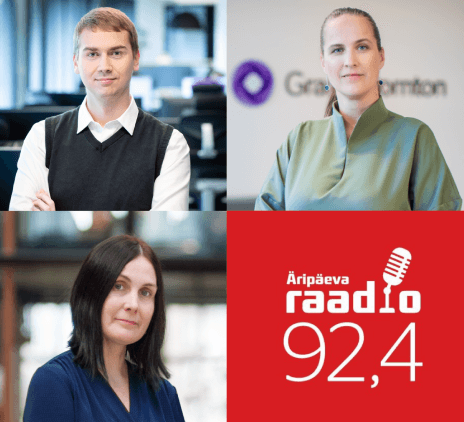
Finding competent top-level specialists is getting harder, forcing companies to adapt on the employee-centred labour market and recruit already today for tomorrow, stated the Äripäev (daily business newspaper) produced radio programme “Kasvukursil”.
Last year was a very successful one for Grant Thornton Baltic – total revenue in Estonia, Latvia and Lithuania grew by 15.1%, reaching 9.3 million euros. The company was able to grow the volumes of all of its services, from accounting and auditing to business advisory and risk management services.
When it is time for the parent to return to work after childcare leave, they are entitled under the Employment Contracts Act to improved work conditions, including a pay raise, if conditions and salary level have improved for other employees in the meantime. Is the returning employee on par with others?
In the beginning of the year, several tax changes were introduced in Estonia, Latvia and Lithuania. Some of the changes will become effective in 2020. In addition we shall highlight tax rates applicable in the Baltics as of 2020.
Though analysts consider the agricultural sector as having high potential for the next year, their optimism doesn’t always pan out. Farmers have to expend effort and cooperate to overcome challenges, as a radio programme produced by the Äripäev business daily, “Kasvukursil” revealed.
Who is an electricity undertaking? What requirements does the ELTS impose on electricity undertakings? Which undertakings should have their activities audited? What precisely is audited? In the following, we draw attention to bottlenecks related to the ELTS and auditing.
Allowing employees to work location-independently is one way of engaging good specialists on today’s labour market. On one hand, it’s a flexible and appealing option for both employee and employer, but it also runs risks. Thus, before entering into a remote work agreement, it’s worth thinking about the rights and responsibilities entailed and whether the employer is ready and capable of hedging all of the risks.
A private limited company in Estonia can be founded with or without making a contribution. Only individuals have the option of starting a company without making the contribution. Legal persons setting up a private limited company must always make a contribution, either monetary or non-monetary.
The technology-centred, open economy is changing at light speed and finding a sustainable competitive edge is an ever sterner test for the business community. Clients and data are becoming companies’ most important assets. This in turn has significantly redefined the role and area of responsibility of the chief financial officer.