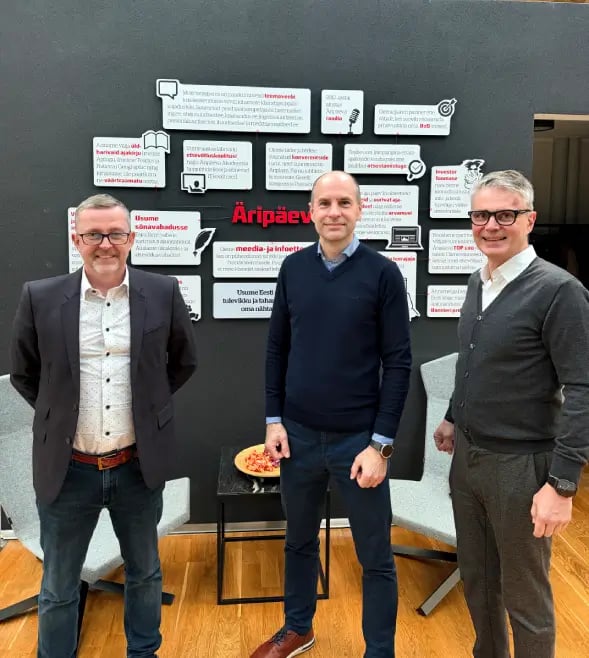
Selling and valuing a business: what attracts investors? Grant Thornton Baltic partner Mart Nõmper and M&A experts discuss Baltic market trends, strategic buyers, family business succession and ways to increase company value.
Filter insights by:
Popular topics
Featured insights
Is your company required to undergo an audit or review? Find out which thresholds apply in Estonia, Latvia and Lithuania, how audits differ from reviews, and when an audit is mandatory regardless of company size.
The new EAS 10 introduces changes to revenue recognition for goods sold with a right of return from 2027. Companies must estimate expected returns, recognise refund liabilities and document management estimates.
2019 has brought several changes to the process of filings made to the employment register. Besides the data currently required, now the working time rate, job title and workplace address must generally be specified.
On 1 January 2019, changes to the Commercial Code came into force, intended to resolve a few problems that have reared their heads in practice.
In the beginning of the year, several tax changes were introduced in Estonia, Latvia and Lithuania. Some of the changes will become effective in 2019. In addition we shall highlight tax rates applicable in the Baltics as of 2019.
Grant Thornton Baltic is proud to be a local payroll partner of ADP in Baltic countries and been named as one of the winners for the 2018 Partner Excellence Award.
Below we list eight main reasons why companies prefer outsourcing payroll operations instead of a dedicated in-house department.
The European Union has adopted new rules on VAT that will simplify and facilitate e-commerce. The rules will come into effect in full on 1 January 2021, but companies that provide electronic services will be able to benefit from the rules already starting 1 January 2019.
It is extremely important for managers to pursue self-improvement. As the saying goes: a fish starts rotting from the head. Unfortunately, managerial culture in Estonia is not at a level we can be satisfied with. We have many companies where money and financial results are managed but where the people are not. Actually, instead of money and results, it’s people who should be managed. If so, the good results will not be long in coming.
This year, a number of large-scale purchase and sale transactions have provided much fodder for discussion in the media – Nelja Energia, Luminor and Utilitas are three examples. The large transactions always stand out, but this year has seen many mid-sized and small company acquisitions as well.
Although employer branding is seen as mainly the domain of personnel and marketing people, it isn’t only their function. Managers have just as important a role here, because it is managers who can leave employees with a good experience of the organisation as employer. Or the opposite – a negative experience, because Estonia has many organisations that have a substandard managerial culture and instead of leading people, they’re busy managing money and processes.
United Motors has purchased the distributor of Peugeot and Hyundai in Estonia. Grant Thornton Baltic provided advisory services for the transaction.
According to Michael Porter, whose book Competitive Strategy is one of the most highly regarded works on management, a company develops a competitive advantage over its rivals when it purposefully differentiates activities from others in order to create unique value.
How to hold on to good employees? For starters, understand that employees may consider leaving, competitors try to outbid you for them, and employees have their own personal career goals.
Food synthesizers, halo environments and a number of other exciting gadgets seen on TV seem like an unattainable dream a Star Trek fan might have come up with. But for how long?
Next year, amendments to the Taxation Act are expected to enter into force. One of the amendments calls for more data to be added to the employment register, which will however increase the workload for accountants.
International commerce is increasingly digital. But the global taxation system is still aimed at traditional “brick and mortar” needs. The action plan of the OECD’s package of measures to combat base erosion and profit shifting (BEPS) acknowledges the need for modernisation. This has been partly achieved after the BEPS Action Plan was released in October 2015.
25 October will mark five months since the entry into force of the General Data Protection Regulation . There was much confusion before that. Companies wondered whether employees’ birthdays could be printed out and tacked to the wall in the break room. Maybe Christmas presents could no longer be given to employees’ children because that, too, would require the children’s personal data to be “processed”.