It has been a year and a few months since the coronavirus turned a new page in world history and exploded all comfort zones. Since that time, Estonia has beaten back two waves of the virus, and like last spring, we are now facing a calmer period. But this brings up new questions – how to return little by little to ordinary working life and juggle the needs of companies and employees while taking into account the way work will be organized in future.
Companies that sell physical goods to European countries all too often have to grapple with the destination country’s complicated VAT system, but in summer 2021, the situation will become simpler and the administrative expenses related to declaration of taxes will decrease.
The sudden surge in remote working, online shopping, digital health and virtual learning boosted demand for business technology and communications solutions. At first glance, the future of technology companies may seem cloudless, but in fact, many of them predict that customer orders will decrease in the future. Find out, what challenges the technology sector is facing in the near future:
Store data correctly and securely, and more importantly, use the data the same way, and you might well find that the benefits easily exceed any direct monetary gains. An expert explains how to make maximum use of data for turning a profit.
Grant Thornton Baltic OÜ experts conducted an analysis of the energy networks belonging to public undertakings at the request of the Strategy Unit of the Government Office of Estonia and it was funded from measure no. 12.2 “Development of quality of policy-making” of priority axis no. 12 “Administrative Capacity” of the Cohesion Fund’s operational programme 2014-2020. The initiator and partner of the project is the Ministry of Economic Affairs and Communications.
In the case of the Finnish tax authorities and A Oy, we can see how incompetent preparation of transfer pricing documentation can create a large administrative burden for the company. Although the case ended in A Oy's favor, they had to spend time and money to have the decision of the Finnish tax authorities to adjust the taxpayer's transfer prices and add additional income tax on the adjusted profits annulled.
Grant Thornton has released a new guide to help international entrepreneurs navigate transfer pricing regulations in different countries and keep up with recent changes.
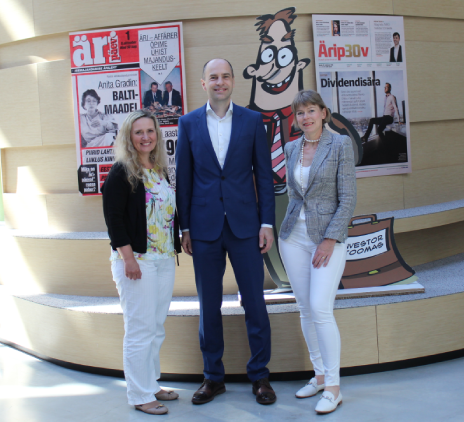
After the year of the coronavirus, there is good reason to review the value of a company’s assets with particular care. Even more, because the value of some assets may instead have increased in these muddled times, as we heard on the Äripäev Radio programme ‘Kasvukursil’, on which Mart Nõmper, Sworn Auditor and Head of Audit and Assurance Services, and Mikk Mägi, Head of Financial Advisory at the pan-Baltic audit, outsourcing and advisory services provider Grant Thornton Baltic, discussed asset valuation.
Mart Nõmper, Sworn Auditor and Head of Audit and Assurance Services, and Mikk Mägi, Head of Financial Advisory at the pan-Baltic audit, outsourcing and advisory services provider Grant Thornton Baltic, spoke about what distinguishes a good financial manager from a mediocre one on the Äripäev Radio programme ‘Kasvukursil’.
A CRM software provides a company with a comprehensive overview of its customer data and relationships, thus, supporting both sales and marketing. As a result, both the company's sales activities and internal efficiency improve. Grant Thornton Baltic's Digital Marketing Strategist Erik Suits has made a practical comparison of the most used CRM sustems. Find out more!
For many companies and institutions, internal audit is a legal obligation that cannot be waived even in difficult economic times. Therefore, the question inevitably arises as to how this obligation is most favorable and reasonable based on the needs of the company - hire your own internal auditor or outsource? Read the article! Grant Thornton Baltic's business risk services adviser Riin Veidenberg will help you with the decision.
There are different reasons for drawing up a business plan and the target groups can vary as well. Detailed business plans are compiled when starting a business or expanding it, entering the market with new services or products and raising capital from investors or lenders to execute your strategies. Grant Thornton Baltic financial advisers Mikk Mägi and Raili Ilves write about the importance of business plan and what are the key points in the plan.
In a crisis, companies need to be able to respond quickly to change and to meet the needs of their employees, customers and partners, while managing the company's financial and operational challenges. Grant Thornton Baltic's Chief Internal Auditor Kai Paalberg names 5 top priorities that all companies should concentrate on when dealing with the crisis management.
Reorganization is being used to help a company that has temporarily become insolvent, for example due to the current pandemic and crisis. It is important to emphasize that a company can be reorganized if the business model is sustainable, and the difficulties are temporary. Grant Thornton Baltic partner Artur Suits opens the subject further in his interview.
The COVID-19 pandemic is placing companies and their management teams in a challenging situation due to the lockdowns and state of emergency established around the world. One of the most critical areas is managing the companies’ cash flows and decisions to maintain liquidity. Mikk Mägi, head of financial advisory in Grant Thornton Baltic, gives advice what should be a priority for the companies during the crisis.
Do companies take time out from everyday business operations for brainstorming on topics related to the company’s development and strategy, and if they do, how frequently?