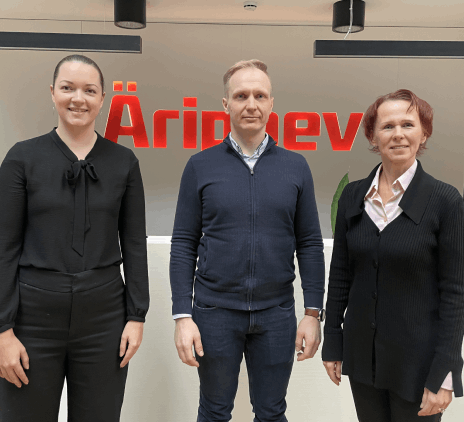
Almost every application employees submit to the labour dispute committee includes a claim for compensation for non-material damage, according to the committee chairs, as described by the Director General of the Labour Inspectorate.
Dividend taxation in Estonia from 2025: when and how to distribute dividends and when tax-free redistribution is possible.
This AI assistant helps assess whether an employment contract complies with applicable labour law and identifies potential risk areas. It is suitable for anyone who wants to perform an initial review of an employment contract document (in PDF or Word), detect shortcomings, and reduce legal risks before using or signing the contract.
In the spring and summer of 2022, Fourings OÜ, which brings together companies engaged in the sale and maintenance of Audis in Estonia, sold a 50 percent stake to the investment company UG Investments.
In August 2022, Grant Thornton Baltic concluded a financial and tax due diligence for an Estonian start-up company Qualitista.
Experts say that activity on the transactions market has returned to previous levels in contrast to the slump in the spring, but it should be remembered that more restrictive conditions are added to contracts in hard times.
Up to 30 December 2021, according to subsection 390 (4) of the Commercial Code it was required that a branch of a foreign company has to be liquidated before deletion from the Commercial Register, with all of the stages necessary for liquidation to be followed: notification of creditors, satisfaction of creditors’ claims, preparation of a final balance sheet, etc.
Most annual reports have by now been submitted and the Commercial Register is now checking whether companies’ equity meets the minimum net assets requirement arising from legislation. What does this mean for companies?
If a company lacks its own HR manager or recruitment specialist, now is not the best time to look for one, because a recruiter is one of the most sought-after and thus most heavily advertised positions on the job market.
Our company celebrates its 30th anniversary in 2022. To store all the important milestones and great events and assure that our story would not be forgotten, we have published the book "Three decades on a path of growth. The story of Grant Thornton Baltic".
Kristel Tiits, a long-term employee of our company and Head of Legal, became a Partner of Grant Thornton Baltic. In total, we now have seven partners in Estonia and 15 in the Baltics.
The Commercial Register Act will enter into force in three stages: the general date of entry into force is 1 February 2023, but the amendments concerning the maintenance of a list of shareholders and a list of building association members will enter into force on 1 September 2023, while the amendments concerning, among other things, the reservation of a business name and the making of entries on a specified date will only enter into force on 1 March 2024.
The Nordic venture capital fund Inventure invested 11.6 million euros in the Estonian startup Jobbatical in 2022.
The three main areas of due diligence are: tax, finance and legal, but it is also possible to conduct a thorough overview of, for instance, the areas of management, marketing, production and IT in order to understand the object of the transaction as a whole.
In our new videos, you can learn about Grant Thornton Baltic's main areas of activity - accounting, auditing and advisory - as well as our culture: yes, we are not dry numbers people, but we appreciate humor, and we are helpful and solution-seeking with both clients and colleagues.
The audit requirement recently applied to crypto companies will notably increase the workload of auditors who are expected to provide a service that is largely lacking in Estonia currently.
On 12 May 2022, the Government of the Republic approved a draft amendment to the Local Government Act that makes internal audit a requirement in local governments. At least once every four years, an internal audit must be conducted to verify that the internal control system meets certain requirements.
From reporting periods starting 2024 onwards, the Corporate Sustainability Reporting Directive (CSRD) will require all large companies to report on sustainability policy and performance.
The European Union directive on transparent and predictable working conditions has been transposed into national law. The corresponding amendments come into force on 1 August 2022, but it would be a good idea for employers to start preparing for this date already.