Companies’ credit agreements generally contain customer-specific conditions called covenants. December is the last chance to check whether the company is indeed in compliance with these covenants, especially considering how companies’ financial results have been impacted by the current ultra-rapid economic growth, rising prices and supply chain problems.
An overview of remote work developments in 15 countries before, during and after the Covid-19 pandemic.
Having data protection affairs in order at a company ensures reliable and trustworthy relations with businesspartners and a stronger position at the negotiating table. On the other hand, problems can mean fines running into the millions of euros even long after the issues are resolved.
Many employers have questions about whether and to what extent personal data can be requested from employees in the context of the coronavirus pandemic. In this article, I highlight some practical questions and concepts that employers should factor into processing of employee personal data and provide advice on how to mitigate the main risks for both employer and employee.
Under the Occupational Health and Safety Act, employers must compile a risk assessment of the working environment. It is mandatory for employers who have at least one employee (security institutions excluded).
In the post-pandemic landscape, a new model of leadership will be needed to enable organisations to thrive. Engendering innovation, collaborating and communicating across the business, and adapting to change have become operational necessities, while empathy and inclusion are the keys to team performance.
It has been a year and a few months since the coronavirus turned a new page in world history and exploded all comfort zones. Since that time, Estonia has beaten back two waves of the virus, and like last spring, we are now facing a calmer period. But this brings up new questions – how to return little by little to ordinary working life and juggle the needs of companies and employees while taking into account the way work will be organized in future.
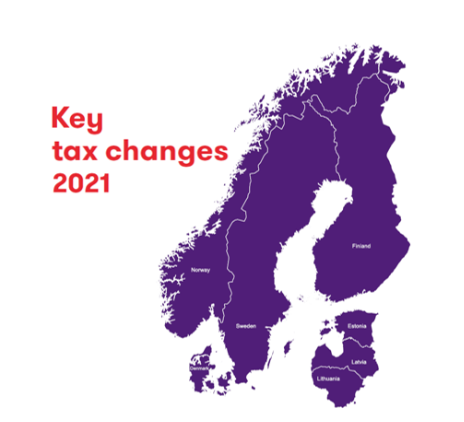
In the beginning of the year, several tax changes were introduced in Nordic-Baltic region. In addition we shall highlight tax rates applicable in the Nordic-Baltic region as of 2021.
The coronavirus restrictions have put many employers in a very difficult situation. When turnover is down, it’s time to analyse what would lead the company through the difficult times – applying for a new salary compensation from the government, temporary pay cuts, leave or layoffs.
The coronavirus crisis, which started a little more than a year ago, changed quite a few things in employment relationships. One of the most important changes has been the widespread use of working from home offices. Provided that the nature of the job had some degree of compatibility with the format, employees were allowed to work remotely by companies and organisations where this had not previously been the practice.
It will soon be time to prepare annual reports for the financial year 2020. Estonian companies with parent companies in the UK will have to take into account new rules.
An annual report can be a great calling card and the secret to doing business more successfully, even though Estonian business people aren’t all that active in submitting them. Last year was an exception: the deadline for submission of annual financial statements was postponed by several months and a larger number of the reports came in on time.
Under a European Union directive, publicly listed companies must adopt the European Single Electronic Format, ESEF. But they will probably not have to file ESEF format annual reports for another year.
After the year of the coronavirus, there is good reason to review the value of a company’s assets with particular care. Even more, because the value of some assets may instead have increased in these muddled times, as we heard on the Äripäev Radio programme ‘Kasvukursil’, on which Mart Nõmper, Sworn Auditor and Head of Audit and Assurance Services, and Mikk Mägi, Head of Financial Advisory at the pan-Baltic audit, outsourcing and advisory services provider Grant Thornton Baltic, discussed asset valuation.
Mart Nõmper, Sworn Auditor and Head of Audit and Assurance Services, and Mikk Mägi, Head of Financial Advisory at the pan-Baltic audit, outsourcing and advisory services provider Grant Thornton Baltic, spoke about what distinguishes a good financial manager from a mediocre one on the Äripäev Radio programme ‘Kasvukursil’.
On 16 July 2020, the European Union Court of Justice (CJEU) passed judgment C-311/18 (Schrems II), invalidating the US-EU certificate programme Privacy Shield, which ensures data transmission security.