If an employer has not taken steps to ensure a psychologically safe work environment, cases involving suspected workplace bullying often end up in the labour dispute committee. If bullying is confirmed, the employer must open their wallet.
“The mildest scenario for an employer is when an employee goes to the Labour Inspectorate to file a complaint,” said Merli Kesküla, leading legal adviser at Grant Thornton Baltic, on the radio show Kasvukursil.
“Someone from the Inspectorate will come knocking on the employer’s door and ask what is going on. Because the Inspectorate provides guidance and wants to help, no penalty payment may follow if the employer genuinely takes the advice into account and improves work organisation and processes,” Kesküla explained.
If, however, a work-related illness cannot be diagnosed, cases involving suspected workplace bullying often end up in the labour dispute committee. “We’re seeing a tremendous increase in the number of applications. This year the committee has issued 14 public decisions, but that does not reflect how many applications on this topic have actually been filed,” she added.
When workplace bullying is confirmed, compensation follows. “These are not small amounts – several thousand euros. It is a real legal risk,” Kesküla emphasised.
The law requires employers to assess and mitigate the psychosocial risk factors in the work environment, including stress and the risk of burnout – in other words, to create a mentally safe workspace. Employers must document and evaluate the frequency and potential impact of risks, as well as develop plans for prevention and management.
Psychosocial risk factors
Psychosocial risk factors relate to work activities and the work environment, and they may cause mental harm to employees, such as occupational stress or burnout. Causes may include poor workplace relationships, psychological violence, excessive workload or unequal treatment. The legal wording is broad in terms of both activities and risks.
The gap between documents and real life
Both Estonian and international studies show that employee stress is increasing. Court decisions reveal that although risks are assessed, they are often evaluated carelessly and in overly general terms. When a requirement feels unnecessary, it’s often done just to tick a box – and the same is true here.
According to Marja Leisk from peaasi.ee, what matters far more than paperwork is genuinely understanding the issue. “We dedicate the best hours of our lives to work. It would be great to go somewhere you actually want to be and where your colleagues are pleasant. Employers shouldn’t see this as completing a document but as building a truly good work environment. The results will be better, too.”
“Workplace safety goes hand in hand with company leadership culture,” said Marge Litvinova, HR Director at Grant Thornton Baltic. If a company values an excellent employee experience, it will work toward it by asking for feedback and checking whether it aligns with management’s expectations. If not, steps must be taken to improve the situation.
Younger generations have started to turn the ship around – they expect meaningful work, the opportunity to express their thoughts, to be heard and to meaningfully contribute to the company’s development. “Psychological safety is a very clear expectation for them; it is essentially basic hygiene,” added Litvinova.
Workplace law evolves in response to new expectations. Kesküla cited the recently adopted variable-hours agreement as an example. However, legislative changes reach employment law with a long delay. Psychosocial risks were included in the law in 2019, and occupational diseases and work-related illnesses arising from these risks were added only a few years later.
“No officially recognised occupational disease caused by psychosocial risk factors has been identified yet, but one case is on the horizon,” Kesküla noted. Practice is still very limited.
Disability benefits made a big leap
In recent years, the number of sick leave certificates issued due to burnout has risen sharply in Estonia. In 2024, the total compensation amount more than doubled, reaching nearly 850,000 euros, according to the Labour Inspectorate.
Proving harm remains difficult
A physical injury is usually visible, but work-related mental health problems are far more difficult to prove. “Occupational diseases are diagnosed by an occupational health physician who does see the company’s risk assessment and the psychosocial risks listed there, but they cannot compare this information with real life,” Kesküla explained. Employees often fear that if they tell a doctor about their mental health concerns, they may lose their job because the employer will be told they cannot cope with their duties.
Leisk added that the onset of illness is also difficult to pinpoint. “Burnout doesn’t appear overnight; it’s not like catching a cold. It grows alongside challenges and anxiety. It is very hard to identify the starting point or to say which of the last three employers is most to blame and what triggered it. Other risk factors also play a role.”
“How can an employee prove they were put in a difficult position because they were on sick leave? How can they prove that the employer belittled them in front of colleagues at the coffee corner? Or that, for some reason, they have not been given the same opportunities as others?” Kesküla asked.
If a case comes down to one person’s word against another’s, the labour dispute committee will rule in favour of the employer. If the employee cannot prove workplace bullying, the committee cannot establish it either.
Bullying must be repeated, long-lasting and intentional. It must include a social dimension, such as a power imbalance where people are not on equal footing. A claim like “my boss yelled at me once” will most likely not qualify as bullying.
If a conflict arises between two colleagues, the employer is also responsible – even if the dispute happens outside work hours. “If it starts affecting work performance, processes or the general atmosphere, it becomes the employer’s problem and must be addressed,” Kesküla explained.
Recording a work accident that happens at an off-site event is a grey area. If participation is voluntary and not related to work, the incident will not be classified as a work accident. But if participation is mandatory – or if, for example, a team leader has a specific role to fulfil and something happens to them – it may be considered a work-related incident.
Toxic environments cannot be compensated with perks
Costly support measures that do not actually improve employee well-being are known as carewash, or fake caring. “Carewash includes one-off small delights that do not change the fact that a person is struggling,” Leisk said. Examples include sports and health days, various counselling services, gyms, and brunches.
Kesküla emphasised that talking to people is far less costly than carewash. Leisk recommended that instead of offering superficial perks, employers should review their processes and talk to their people. Annual one-to-one development discussions are not enough – conversations should happen at least quarterly, if not monthly. This helps prevent burnout and reduces the need to replace employees. More frequent conversations also help identify concerns early.
During these discussions, employers might even gain ideas on how to reorganise work and reduce stress across the organisation.
How employers can prevent additional pressure
- Make sure the employee knows what is expected of them. Clear goals and performance criteria reduce stress.
- Build a trusted team and hold one-to-one conversations. This prevents reflexive suspicion of dishonesty.
- Create a safe culture. Employees must feel that if they speak about a concern, they won’t be ridiculed and their worry will be taken seriously.
- In recruitment, involve not only HR but also the direct manager and even the team to assess compatibility.
- If an employee requests it, allow a temporary reduction in workload. Set a review date to assess their progress and decide together how to proceed if their capacity has not returned.
- Remember that a person is a whole human being, and their difficulties may have nothing to do with work.
- Build strong relationships with employees. Support this through shared activities, smaller project teams and more frequent celebrations – not only once a year but when something goes well. Off-site events also help people get to know each other, reducing competition and bullying.
- Train your leaders so they can handle conflicts and feel supported themselves. Develop a feedback culture and offer leadership development programmes. For example, Grant Thornton Baltic has created a leaders’ club for sharing successes and failures.
- Follow your own rules and ensure that words match actions.
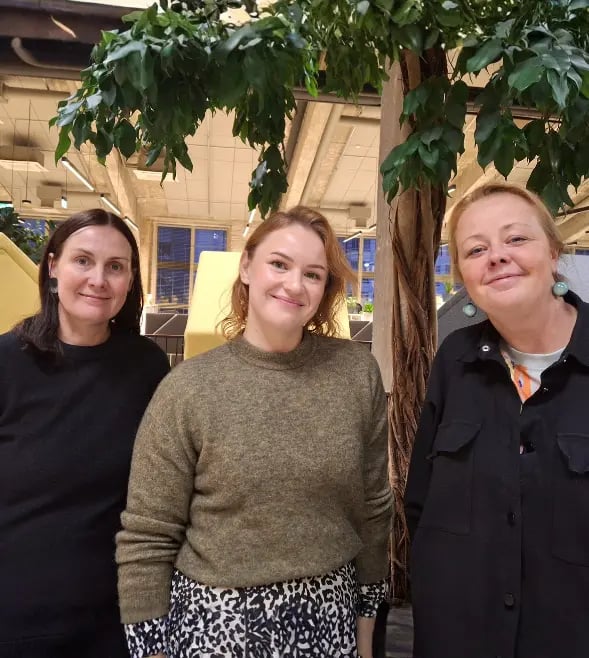
In the photo from left to right: Marge Litvinova, Merli Kesküla, Marja Leisk
Photo credit: Lauri Leet