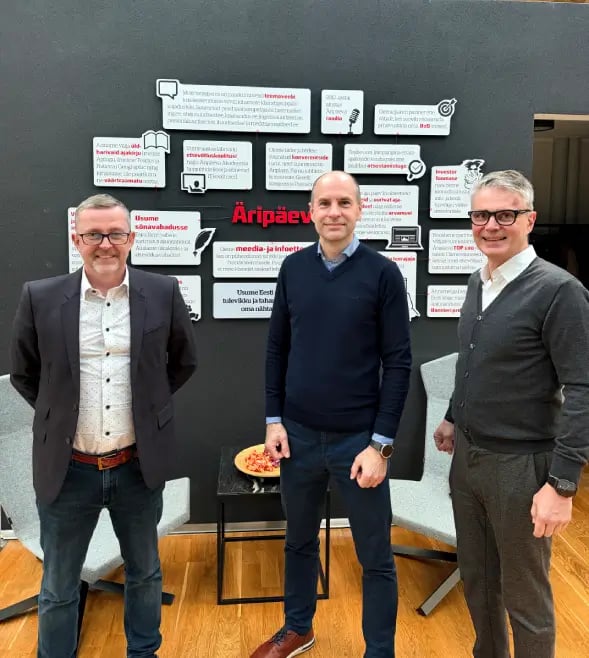
Selling and valuing a business: what attracts investors? Grant Thornton Baltic partner Mart Nõmper and M&A experts discuss Baltic market trends, strategic buyers, family business succession and ways to increase company value.
Filter insights by:
Popular topics
Featured insights
Is your company required to undergo an audit or review? Find out which thresholds apply in Estonia, Latvia and Lithuania, how audits differ from reviews, and when an audit is mandatory regardless of company size.
The new EAS 10 introduces changes to revenue recognition for goods sold with a right of return from 2027. Companies must estimate expected returns, recognise refund liabilities and document management estimates.
Though analysts consider the agricultural sector as having high potential for the next year, their optimism doesn’t always pan out. Farmers have to expend effort and cooperate to overcome challenges, as a radio programme produced by the Äripäev business daily, “Kasvukursil” revealed.
In the beginning of the year, several tax changes were introduced in Estonia, Latvia and Lithuania. Some of the changes will become effective in 2020. In addition we shall highlight tax rates applicable in the Baltics as of 2020.
Who is an electricity undertaking? What requirements does the ELTS impose on electricity undertakings? Which undertakings should have their activities audited? What precisely is audited? In the following, we draw attention to bottlenecks related to the ELTS and auditing.
Allowing employees to work location-independently is one way of engaging good specialists on today’s labour market. On one hand, it’s a flexible and appealing option for both employee and employer, but it also runs risks. Thus, before entering into a remote work agreement, it’s worth thinking about the rights and responsibilities entailed and whether the employer is ready and capable of hedging all of the risks.
A private limited company in Estonia can be founded with or without making a contribution. Only individuals have the option of starting a company without making the contribution. Legal persons setting up a private limited company must always make a contribution, either monetary or non-monetary.
The technology-centred, open economy is changing at light speed and finding a sustainable competitive edge is an ever sterner test for the business community. Clients and data are becoming companies’ most important assets. This in turn has significantly redefined the role and area of responsibility of the chief financial officer.
Some of you of a certain age reading this post will remember in the mid-1980s, the representation of an Artificial Intelligence character called Max Headroom. (For those of you a little younger, look for Max Headroom in an Internet search engine). The background story provided for the Max Headroom character in his original appearance comes from a concept of a future dominated by television and large corporations.
I am frequently challenged that cash equivalents at the year-end should include those financial assets that have reached a maturity of less than three months at the year-end date, having had a somewhat longer maturity when first acquired. How wrong the understanding!
Although planning and goal-setting takes place both in the long term and monthly (or at least quarterly) basis, the question becomes an urgent one for management at a time when the next year’s goals and action plans have to be drawn up. Budgeting is very closely connected to strategic planning. Through this manner, accountants and financial analysts have a direct role in the organisation’s development.
A stock-taking or physical inventory performed in a quality manner gives the heads of all units in a company assurance that financial statements and databases present a true and fair view of assets and inventories in stock. Periodic stock-taking is also quite effective for preventing fraud.
Companies that follow IFRS accounting standards were required to make the transition to recognizing and accounting for operating lease agreements according to new principles at the latest starting from reporting periods commencing on 1 January 2019.
An annual audit is an indispensable resource for obtaining assurance that a company’s financial statements and accounting is free from material misstatements. One of the most important preconditions for productive cooperation between auditor and the company is adherence to deadlines and being ready for the audit at the agreed time.
Stock-taking quality depends on preparation for and performing of the physical inventory. In the following, I will provide an overview of what to devote attention to while performing it.
For several years now, new thresholds have been in force for auditing annual reports, which exempted many companies from the obligation to have their annual reports audited. From the company’s viewpoint, it may seem a good solution to be rid of the audit or review obligation: less work and financial expense. Yet the other side of the coin should be considered – what do the company and the public have to lose?