Waste collection, property maintenance and other seemingly unappealing businesses can offer investors greater stability than sectors everyone wants to enter.
Less glamorous industries tend to keep opportunistic competitors away, creating opportunities to steadily improve productivity, revenue and business value, said Risto Vahimets, partner at Ellex Raidla, on the Kasvukursil podcast.
“If it's waste collection or something similar that makes people think, ‘That smells’, then it's a great business. Nobody ends up in that sector by accident,” Vahimets said. According to him, these industries attract people who genuinely want to do the work rather than those simply chasing the latest trend.
The opposite is true in popular sectors. “As soon as a business becomes fashionable and people think everything smells wonderful and the world is full of flowers, you get all sorts of strange competitors – and plenty of them,” Vahimets said.
This does not mean that every waste management, security or maintenance company is automatically a good acquisition. Investors assess whether a company has stable cash flow, a strong market position, clear management structures and opportunities for growth. However, everyday service industries often provide a solid foundation for building businesses that generate consistent returns and whose value buyers can recognise.
Capital has not disappeared from the market
The Baltic M&A market slowed in the first half of the year. According to Ellex Raidla's M&A transaction radar, the number of mergers and acquisitions declined compared with the previous period. Preliminary third-quarter figures, however, indicated renewed growth.
Vahimets emphasised that fewer transactions do not mean buyers have run out of money. Capital remains available, but investors are becoming considerably more selective. They are looking for businesses with credible growth prospects and manageable risks.
A similar pattern emerged across Europe. While the overall number of transactions declined, the number of mega-deals worth at least €1 billion increased. Their combined value in Europe was 28% higher in the first half of the year than during the same period a year earlier.
This suggests that competition for large, well-established businesses remains strong. Smaller companies, businesses heavily dependent on their owners and those with unclear business models must work harder to attract buyers.
Defence and food industries attract growing investor interest
Investor preferences have also shifted across sectors in recent years.
Vahimets highlighted the defence industry as one of the emerging trends. Just a few years ago, defence was excluded from the investment mandates of many funds and family offices. Russia's full-scale invasion of Ukraine fundamentally changed that attitude.
New funds specialising in defence investments have entered the market, while existing investors have relaxed their restrictions. Many defence companies are still in the early stages of growth, meaning capital raising remains an important activity alongside traditional M&A transactions.
Another increasingly attractive sector is food production.
The podcast discussed the sale of E-Piim's production facilities to Middle Eastern investors and Orkla's sale of its Põltsamaa business to Svensky Kaubandus. Food production is increasingly being viewed through the lens of food security.
Vahimets pointed out that the question is not simply whether a factory gains access to capital and growth opportunities. It is also important to consider whose food security is actually strengthened when domestic production assets are sold to foreign investors.
Strategic buyers maintain their advantage
Strategic buyers accounted for 73% of transactions in the Baltic market, compared with 17% involving financial investors.
Strategic buyers typically acquire companies that complement or strengthen their existing operations. An acquisition may bring additional customers, production capacity, new services or market share.
Financial investors, by contrast, generally acquire businesses with the aim of increasing their value and selling them several years later.
According to Vahimets, private equity funds are facing a more challenging environment than in the previous decade. Many portfolio companies have remained under fund ownership longer than originally planned.
Some businesses have been difficult to sell at an acceptable price, while others have failed to achieve their expected growth. This also makes raising new capital more difficult, as investors want to see successful exits from previous investments.
Meanwhile, many larger companies have strong balance sheets and can approach acquisitions with a longer-term perspective.
Family-owned businesses and family offices generally do not face the same pressure to exit investments within five to seven years.
Sellers therefore need to understand who their potential buyers are and what those buyers hope to achieve through an acquisition.
Selling a family business is not a failure
According to the M&A transaction radar, the proportion of transactions involving businesses owned by individuals and families increased from 29% to 41%.
This does not necessarily mean that Estonian family businesses have become weaker.
Many entrepreneurs who established their companies in the early 1990s have reached a stage where they must decide whether the next generation will take over or whether the business should find a new owner.
Vahimets stressed that succession in a family business cannot be arranged overnight.
If an owner has not involved their children in the business, given them responsibility or taught them how the company operates over many years, attempting to do so at the age of 65 or 70 may be too late.
In such circumstances, selling the company may be the most sensible decision.
At the same time, Vahimets believes that continuity across generations plays an important role in supporting Estonia's economic growth.
Many companies that expanded from small domestic markets into international businesses did not achieve their greatest success under the first generation of ownership. Their major breakthrough came when subsequent generations became involved and took the family's business ambitions to a new level.
Prepare your business before putting it up for sale
Mart Nõmper, partner at Grant Thornton Baltic, compared preparing a company for sale to preparing an apartment for the property market.
For a business, this means putting management processes, contracts, assets and finances in order.
Sellers must demonstrate growth and momentum rather than simply showing that the business is maintaining its current position. They should also consider whether the company's structure meets potential buyers' expectations.
According to Vahimets, Estonian businesses often grow opportunistically.
Owners add new business activities when opportunities arise or when they identify potential synergies. While this may work well for the existing owner, a buyer might see several distinct businesses within a single company and prefer to acquire them separately.
Company size also matters.
In smaller businesses, management knowledge, data and customer relationships may be concentrated in the owner's hands. If that person leaves, the buyer faces additional risk – and higher risk reduces the price they are willing to pay.
One potential solution is consolidation with competitors.
Higher revenue, clearer management structures and a stronger market position can make a company more attractive to potential buyers.
Nõmper encouraged entrepreneurs looking to increase their company's value to consider whether joining forces with competitors could create a stronger business.
No spreadsheet can determine a company's true value
A company's value can be assessed using revenue, EBITDA, profit or cash flow.
The more stable and predictable its cash flow, the more confidently buyers can apply conventional valuation multiples. These compare the purchase price with annual EBITDA, revenue, profit or another financial indicator.
Technology and service businesses are often more difficult to value because their worth depends more heavily on future developments, including their people, customer relationships, technology and growth opportunities.
According to Vahimets, the potential impact of artificial intelligence must now be considered when evaluating any business.
The question is not only how AI could improve productivity. Buyers must also consider whether AI could fundamentally change the way a company creates value.
If the answer is yes, the acquisition price may turn out to be too high.
Aare Tammemäe, partner at Redgate Capital, added that buyers sometimes overpay for anticipated synergies.
On paper, combining two businesses may promise substantial cost savings and cross-selling opportunities. In practice, however, those benefits may not materialise to the expected extent.
Sellers, meanwhile, tend to overestimate the value of historical investments for which a new owner may not be willing to pay.
Ultimately, a company's market value becomes clear when there is a buyer at the negotiating table – preferably several.
“If there are no buyers, the company has no value,” Vahimets summarised one of the harshest realities of the M&A market.
The podcast also explored the five-billion-dollar transaction involving Grant Thornton Advisory and CBIZ, the valuation of professional services firms, pressure on investment funds to exit their holdings, and why market leadership is particularly valuable to buyers in a small market such as Estonia.
The episode was hosted by Joonas-Hendrik Mägi.
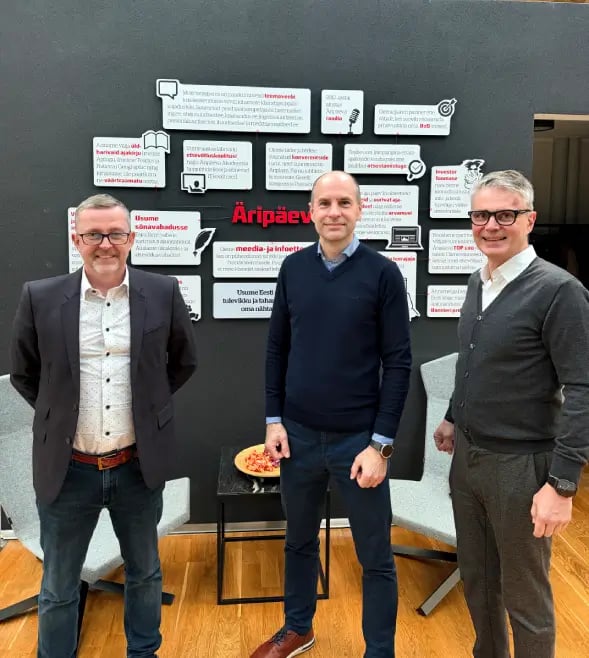
In the banner image, from left: Risto Vahimets, Mart Nõmper and Aare Tammemäe.
Photo: Joonas-Hendrik Mägi.