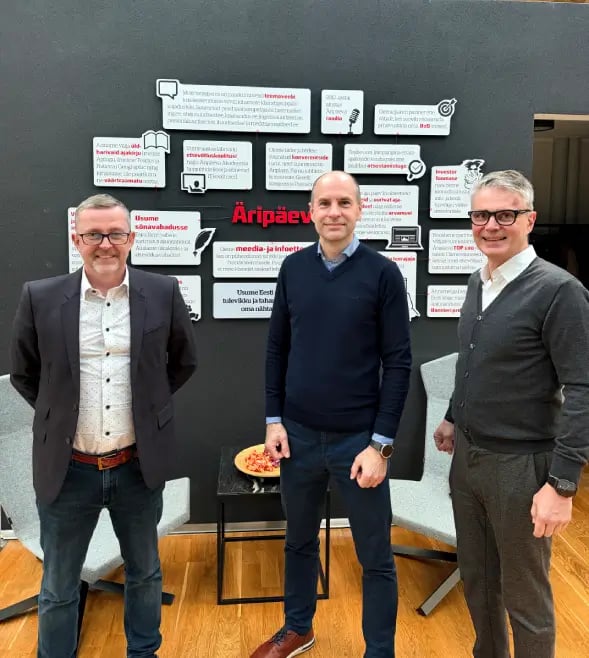
Selling and valuing a business: what attracts investors? Grant Thornton Baltic partner Mart Nõmper and M&A experts discuss Baltic market trends, strategic buyers, family business succession and ways to increase company value.
Filter insights by:
Popular topics
Featured insights
Is your company required to undergo an audit or review? Find out which thresholds apply in Estonia, Latvia and Lithuania, how audits differ from reviews, and when an audit is mandatory regardless of company size.
The new EAS 10 introduces changes to revenue recognition for goods sold with a right of return from 2027. Companies must estimate expected returns, recognise refund liabilities and document management estimates.
How has the auditors’ market changed and why is it hard to find sufficiently qualified specialists? What sorts of trends will global competition, workforce shortage and sustainability reporting requirements bring about?
The details of the defense tax that will take a bite out of corporate profits appear to be rife with inequality and unfairness, and a closer look reveals situations where taxes must be paid by those who haven’t turned an actual profit.
An overview of remote work developments in 15 countries before, during and after the Covid-19 pandemic.
This fall, a record of six new partners joined Grant Thornton Baltic. Four of them are from our Estonian company and one each from Latvia and Lithuania. Now we have a total of 21 partners.
Starting 1 January 2024, a global minimum tax obligation is in effect for large multinational enterprise groups with consolidated revenue of more than 750 million euros in European Union member states and many third countries (such as UK, Switzerland, Canada, Australia, Singapore etc.)
On 25 September 2024, the Estonian government submitted a draft law on the defense tax to the Parliament, which introduces a temporary defense tax consisting of three components, including a 2% tax on corporate profits. Most companies will have to pay the defense tax for the first time on 10 September 2026.
Grant Thornton pays great attention to training managers, and Kristel Tiits (Head of Legal) and I had the opportunity to participate in Grant Thornton International's year-long management training program, where one session took us to Vietnam.
Matters concerning evaluation of the creditworthiness of consumers have returned to the focus during the last year. Discussions revolve around consumers’ increased loan burden and share of loans in default; there is lobbying for additional support from the establishment of a positive credit registry, and the Financial Inspectorate has started getting tougher with fines on market participants who don’t abide by the rules.
Those operating in the financial sector are bound by various laws along with requirements for internal audit arising from those laws. In addition, the Auditors Activities Act governs the provision of internal audit service, defining who is allowed to be engaged in the professional activities of an internal auditor.
The main goal of the channel is to give employees a possibility of confidentially reporting violations. Employees must have a way of doing so orally, in writing or both. It is considered important to consider the nature of the company and its workforce.
Pursuant to amendments that entered into force last year, the Commercial Register can fine or compulsorily dissolve those who are late filing an annual report. Compulsory dissolution can be done if the company lacks registered assets (i.e. no assets evident in the land register, ship register, Commercial Register or Estonian securities register), is not a party to any current judicial proceedings, criminal enforcement proceedings or tax disputes.
Anyone who has to consider any aspect of cybersecurity at their company has probably heard the sonorous sounding terms NIS 2, DORA, E-ITS or even ISO 27001.
E-invoices celebrate their first minor anniversary – submitting invoices to the public sector in this format has been obligatory for five years, while technical support for e-invoicing has existed on the market for more than 10 years. But the hope that the private sector would organically embrace the state’s role model has not come to fruition.
The rules on the contact person underwent a facelift as part of company law reform, the majority of the amendments of which came into force on 1 February 2023.
Last year, an amendment to the Commercial Register Act was passed, which meant more fines for companies for the purpose of making the Estonian business environment more transparent.